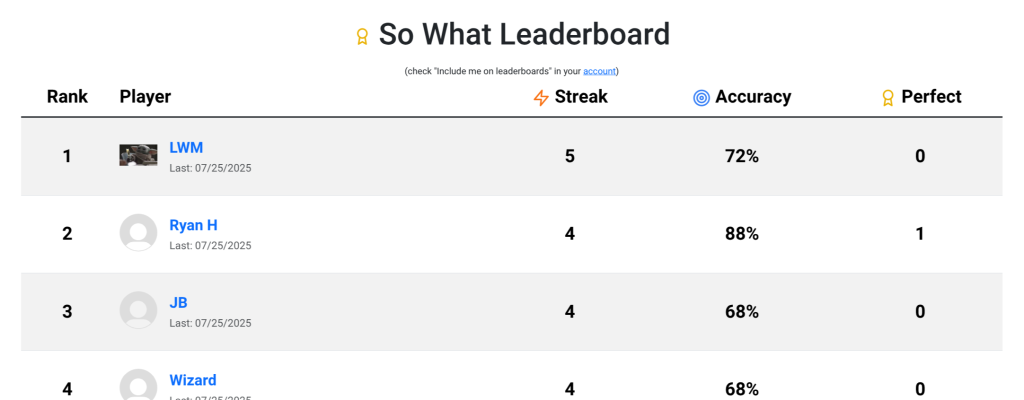
We’ve introduced real-time leader boards for each publisher’s quiz community.
Whether you’re a creator who is writing on Substack or podcasting on SoundCloud or broadcasting on Youtube or driving subscriptions on Patreon, leader boards are a great way to engage fans and reduce subscriber churn.
A public leader board is another gear in a virtuous cycle that nudges people to take quizzes, register, add a personal avatar, compete, and obsess about streaks. Competition turns content into community. (Too much alliteration?)
The gold-standard test for Quizlab’s efficacy is our software’s ability to produce interesting and amusing quizzes without any human editing of both questions and answers.
That’s a high hurdle — not one, frankly, we’ve yet fully surpassed. But we’re trying!
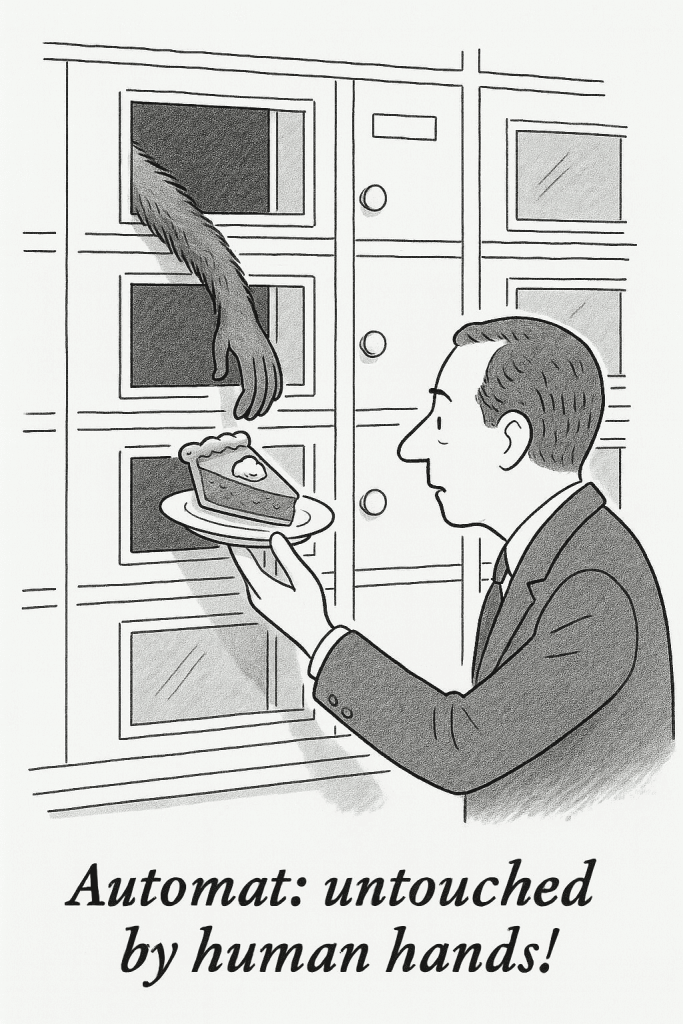
Thinking about this test, I recalled a New Yorker cartoon about Automat, the midcentury chain that replaced wait-staff with shelves of glass boxes so customers could self-serve. One of Automat’s slogans was “untouched by human hands.” I couldn’t find the cartoon on Google, so asked for ChatGPT’s help reproducing it.
What you see is the second try — ironically, the first iteration featured the spelling “untoucched.”
Programmer and newsletter author Molly White has a complete write-up here comparing newsletter engines Substack, Ghost, Beehiiv, Buttondown and Mailchip. She’s shared exhaustive spreadsheets comparing the costs at different subscription levels.
In short, “Cheapest option is self-hosting, though of course there is added time cost and a technical barrier to entry. I pay $100–$150/mo to self-host Ghost with a bit over 25,000 subscribers.For free newsletters, Beehiiv is free for up to 2,500 subscribers. ConvertKit is free up to 10,000.”
A newly published study indicates that up to 40% of medical studies are now written using LLMs.
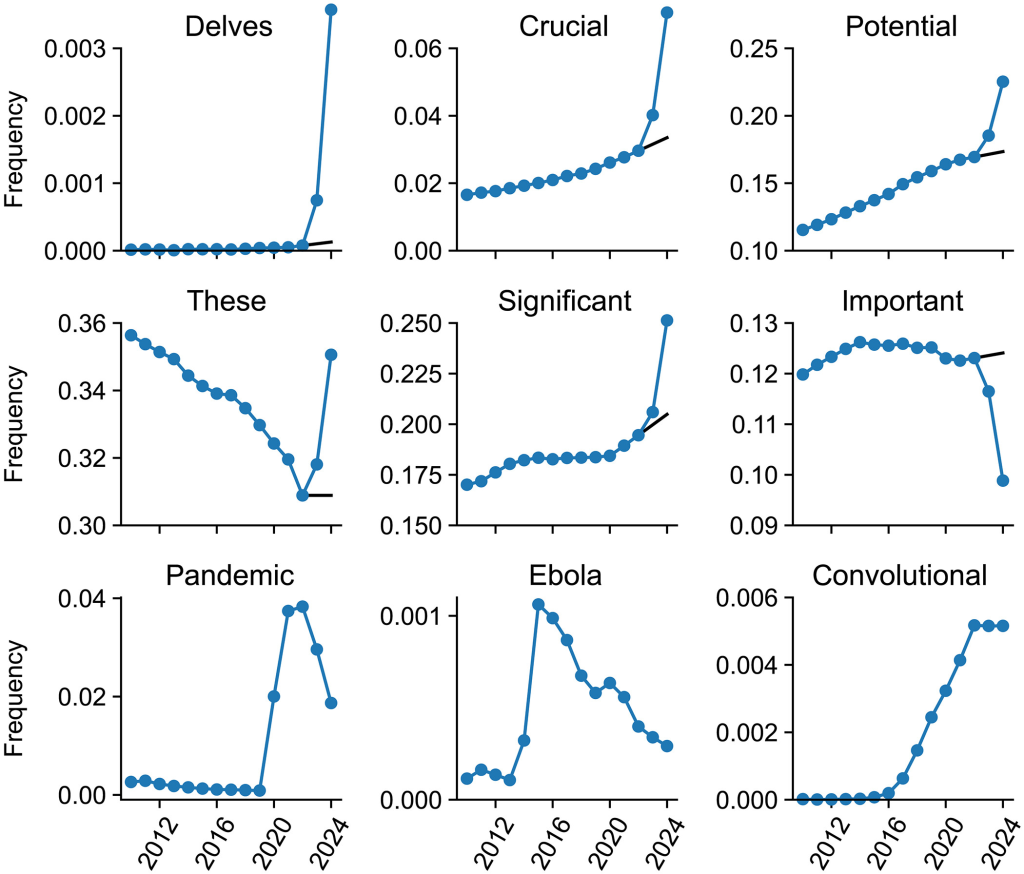
The study sifted through 15 million biomedical abstracts published 2010–2024 looking for LLM “fingerprints” like excess words, IE words that appeared with much greater frequency from one period to the next.
“This excess word analysis suggests that at least 13.5% of 2024 abstracts were processed with LLMs. This lower bound differed across disciplines, countries, and journals, reaching 40% for some subcorpora.”
I must say, these crucial charts were significant and had potential to shock readers!
The study ends by noting: “We did not use any LLMs for writing or editing the manuscript.”
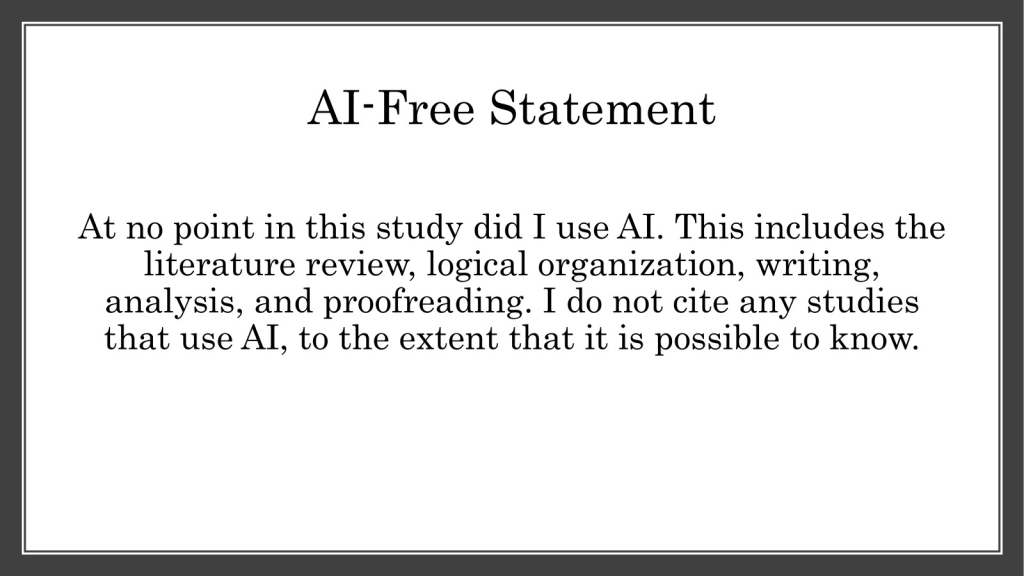
Meanwhile, on Bluesky some academics are loudly professing their AI-abstinence and/or abhorance. See this thread, which started with the following slide that an academic says he now includes whenever he presents at a conference:
The Internet, or at least the giant swath of original content that depends on visitors from Google for discovery or ad views, is being supplanted by AI summaries, claims Cloudflare CEO Matthew Prince.
Less than 3 years after the launch of ChatGPT popularized AI, AI’s dominance is already strong… and accelerating.
According to Prince:
Ten years ago, 2 pages scraped by Google eventually turned into at least one visitor.
Six months ago, six pages scraped would ultimately result in one visitor.
Six months later — now — Google sends just one visitor for every 18 pages it scrapes.
According to Google, 75% of queries get answered by Google AI summaries, and those searchers don’t bother clicking through to the source content.
The situation is even more extreme when you look at other AI engines.
Six months ago, 250 people had to query ChatGPT to translate into one outbound click to the original content. Today that number is 1,500 to 1.
At Antrhopic (Claude.ai), 6,000 queries turned into one click six months ago. Today, 60,000 queries yield just one click to original content.
In short, “people aren’t following the footnotes,” said Prince. “They trust AI.”
Even the web’s strongest content creators are in jeopardy. One in three visits to NYTimes.com from search.
According to Prince, Cloudflare plans soon to announce plans to spearhead a consortium that prevents AI companies from scraping original content without permission or compensation.
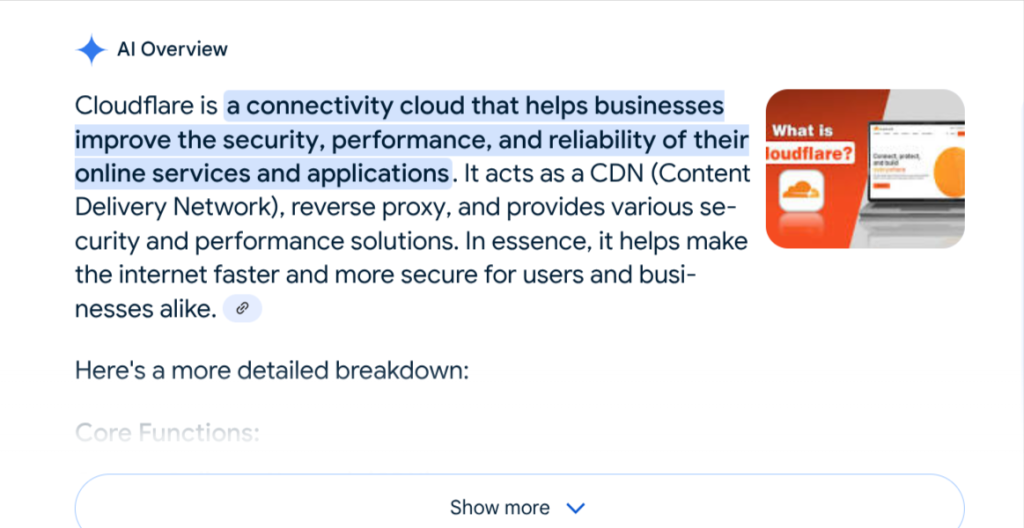
BTW, you may be wondering, what’s Cloudflare? Here’s Goggle’s AI summary…
I’ve played Bloomberg’s new betting quiz game — “Pointed: the news quiz for risk-takers” — a few times. But so far, the mechanics feel arbitrary and complex. Rather than amplifying my enjoyment, the topic-based weighting of points get in the way of my fun.
Bloomberg built its new quiz game to engage consumers who aren’t yet subscribers, Marissa Zanetti-Crume, Bloomberg’s global head of product, told A Media Operator.
“[Pointed is] designed to reach new audiences who may not already be visiting Bloomberg.com, as well as engage existing readers who want to interact with the news in a more playful format that inspires their competitive spirit. The strategy behind Pointed is to combine entertainment and news in a way that feels brand-consistent to Bloomberg. It was built to support three key goals: attract new subscribers, engage existing subscribers and drive conversion.”
“Each of our products is a piece of a larger puzzle that meets different user behaviors and needs, thoughtfully layered together to create a comprehensive 360-degree experience. That’s what ultimately drives conversation and retention,” Zanetti-Crume said.
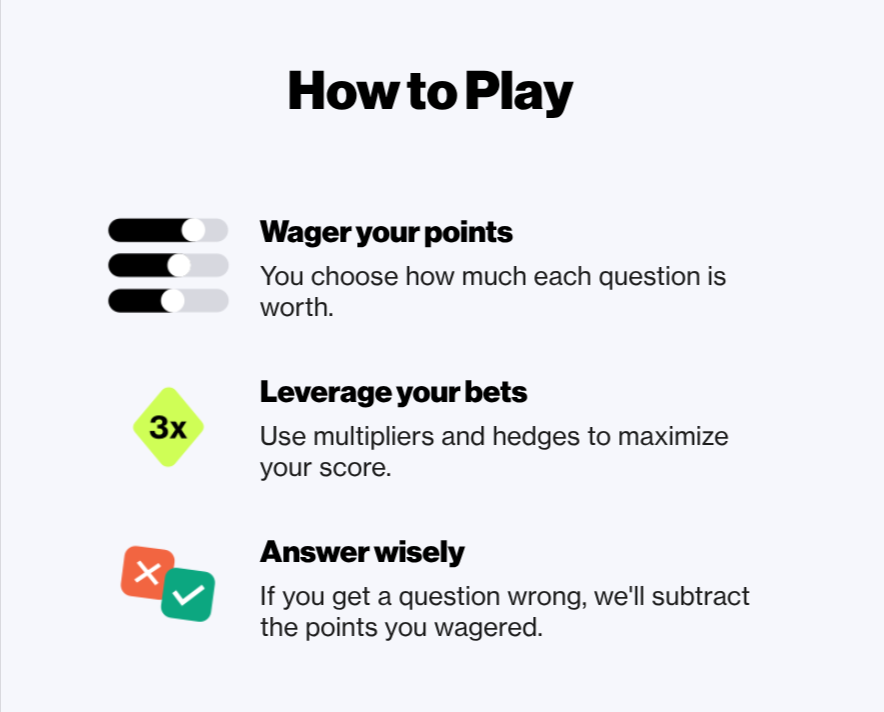
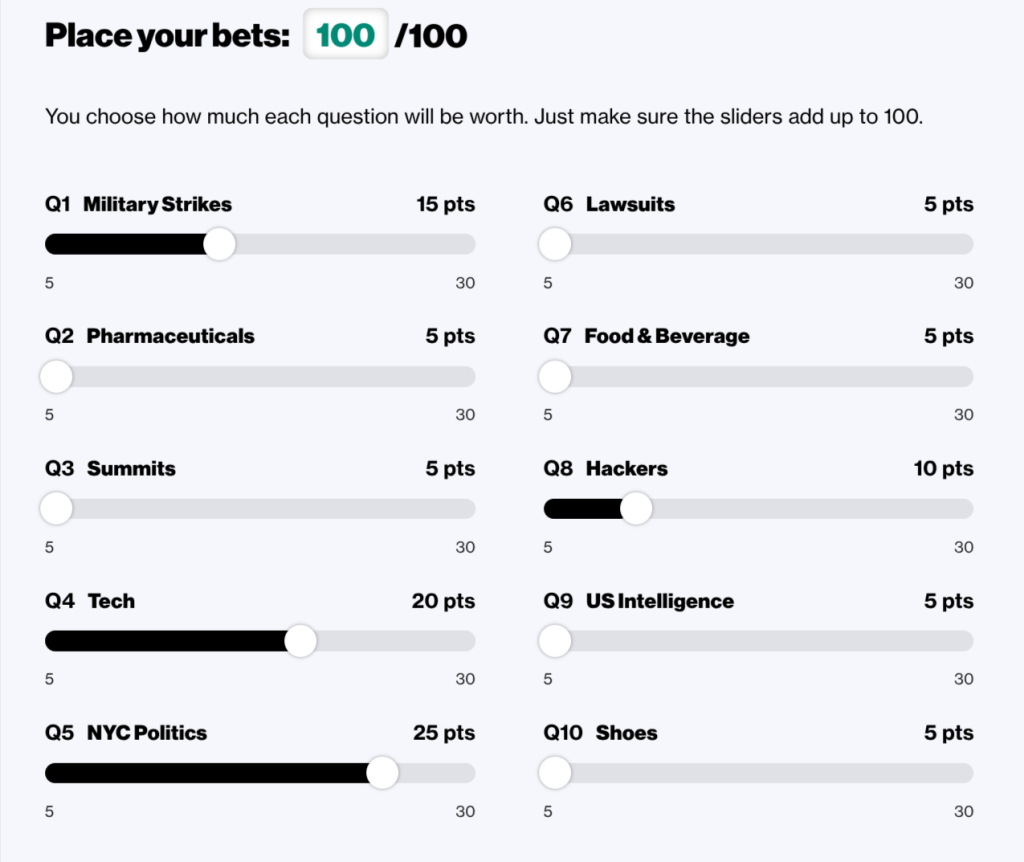
There are two types of leverage: first weighting your confidence on specific topics, and then adding an additional multiplier on the points you can win.
Here’s Bloomberg’s explanation of the game…
And here are my weightings for this week’s quiz… the total can’t exceed 100.
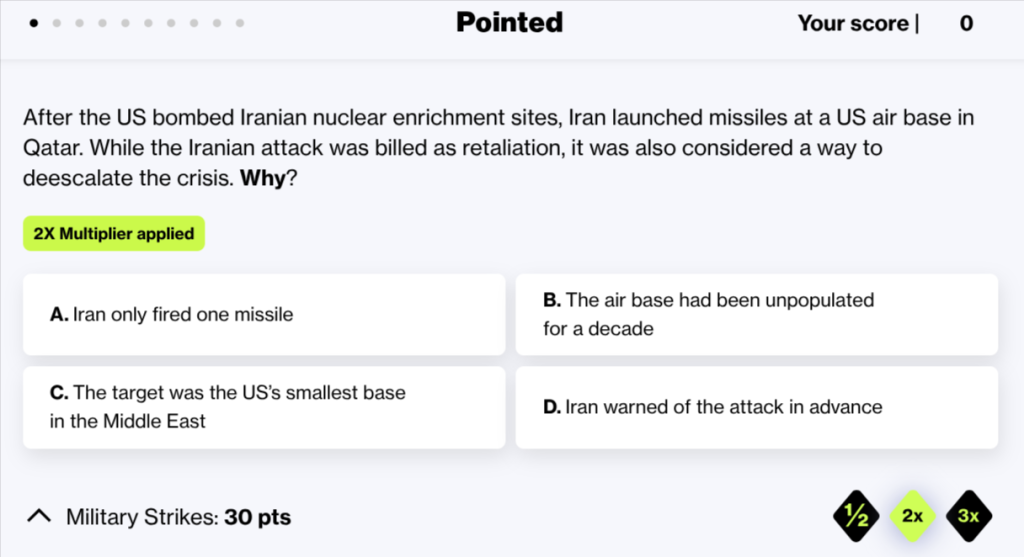
I made a “2x bet” for this question…
And here’s the outcome of my correct bet. I wish I they noted the extra points I’d won and my new total!
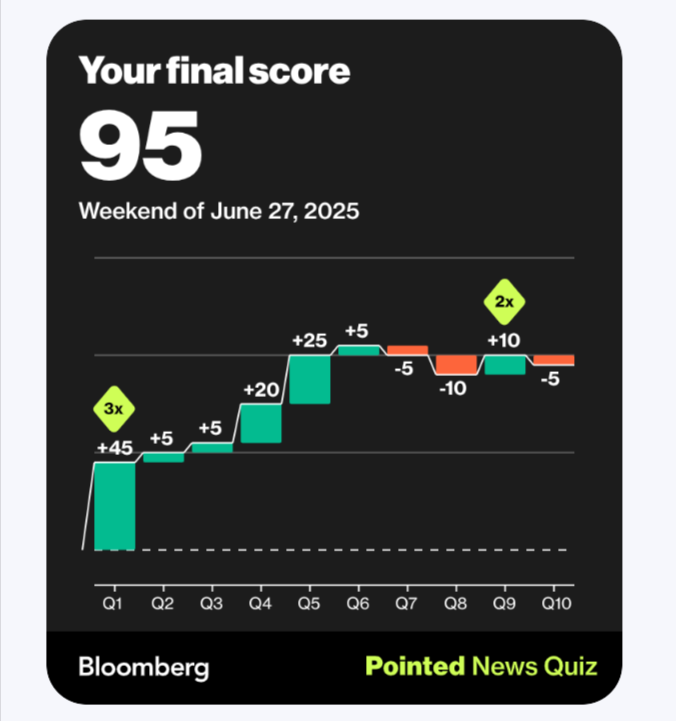
My final results round by round with my weightings factored in…
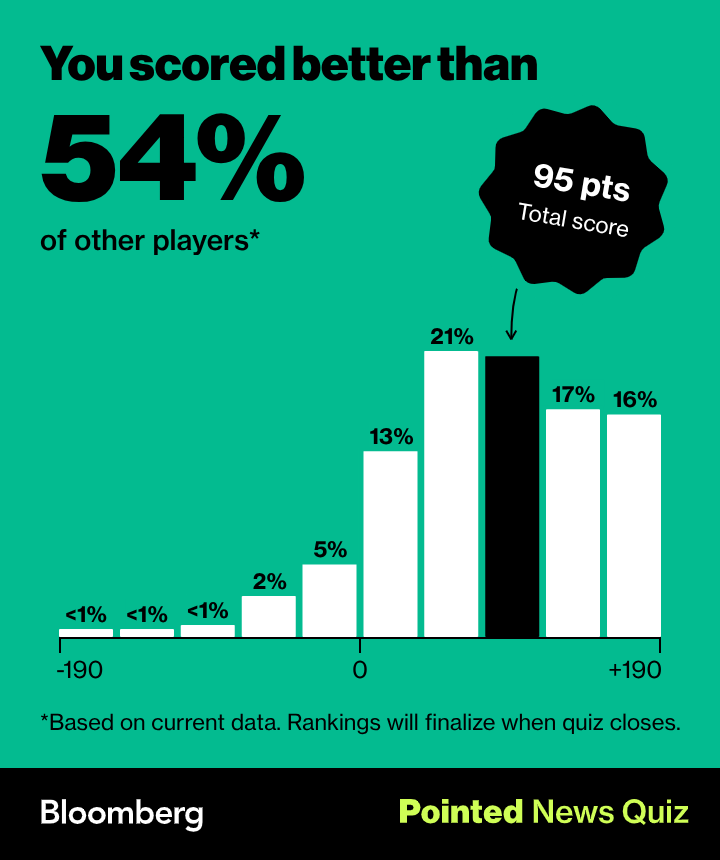
And finally my results versus those of other quiz takers…
My bet is we’ll see Bloomberg symplify their game, stripping out one or both of the multiplier mechanics.
Stacks, a new game, is kind of like Tetris meets Wordle, Madison says. You have a bank of words that you have to place in the correct order, on top of letters already on the board, to form other words.
In Fluxis, another new game, you try to figure out words that build off the previous word and incorporate some kind of characteristic. Madison showed me an example of needing to build an adjective off the word “checkerboard” — he went with “arduous.”
Caleb’s Inferno Crossword Puzzle, which is already included in the monthly Atlantic magazine and available online, is last game Madison showed me. Caleb’s crossword is a narrow rectangle instead of a square, but as you move farther down the puzzle, the clues get more difficult to solve.
Several major publications, including The Atlantic, have entered into corporate partnerships with OpenAI and other AI firms. Any number of experiments have ensued—publishers have used the software to help translate work into different languages, draft headlines, and write summaries or even articles. But perhaps no publication has gone further than the Italian newspaper Il Foglio. For one month, beginning in late March, Il Foglio printed a daily insert consisting of four pages of AI-written articles and headlines. Each day, Il Foglio’s top editor, Claudio Cerasa, asked ChatGPT Pro to write articles on various topics—Italian politics, J. D. Vance, AI itself. Two humans reviewed the outputs for mistakes, sometimes deciding to leave in minor errors as evidence of AI’s fallibility and, at other times, asking ChatGPT to rewrite an article. The insert, titled Il Foglio AI, was almost immediately covered by newspapers around the world. “It’s impossible to hide AI,” Cerasa told me recently. “And you have to understand that it’s like the wind; you have to manage it.”
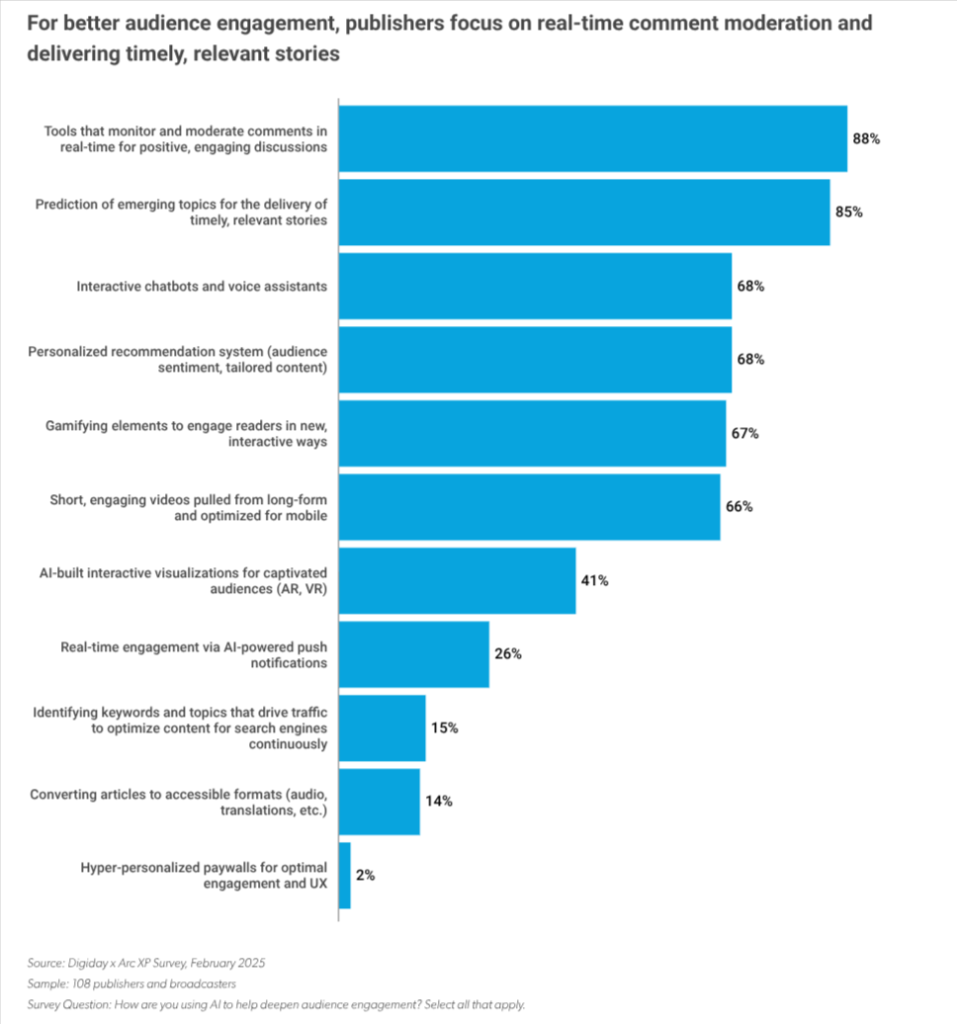
Big publishers are busy gamifying content, according to a new Digiday survey of 108 publishers and broadcasters. How long before j-schools offer degrees in gamification?
Last weekend, the Chicago Sun-Times published a Summer Reading Roundup comprised of a bunch of AI-hallucinated content.
According to Substack author and book publicist/marketer Kathleen Schmidt, “Most of the books on the list don’t exist and were not written by the authors mentioned in the piece. Isabel Allende didn’t write “Tidewater Dreams.” Rumaan Alam didn’t write “The Longest Day.” Rebecca Makkai didn’t write “Boiling Point.” Those books don’t exist. Maggie O’Farrell didn’t write “Migrations” (Charlotte McConaghy did)…