Reports Logan Sachon: “In the last few years, more people are spending a significant amount of money on email newsletters from their favorite writers. As a result, some have also fallen into a familiar budgeting trap: It can be difficult to keep track of how many newsletters they’ve signed up for and how much they’re paying for them.”
First quiz
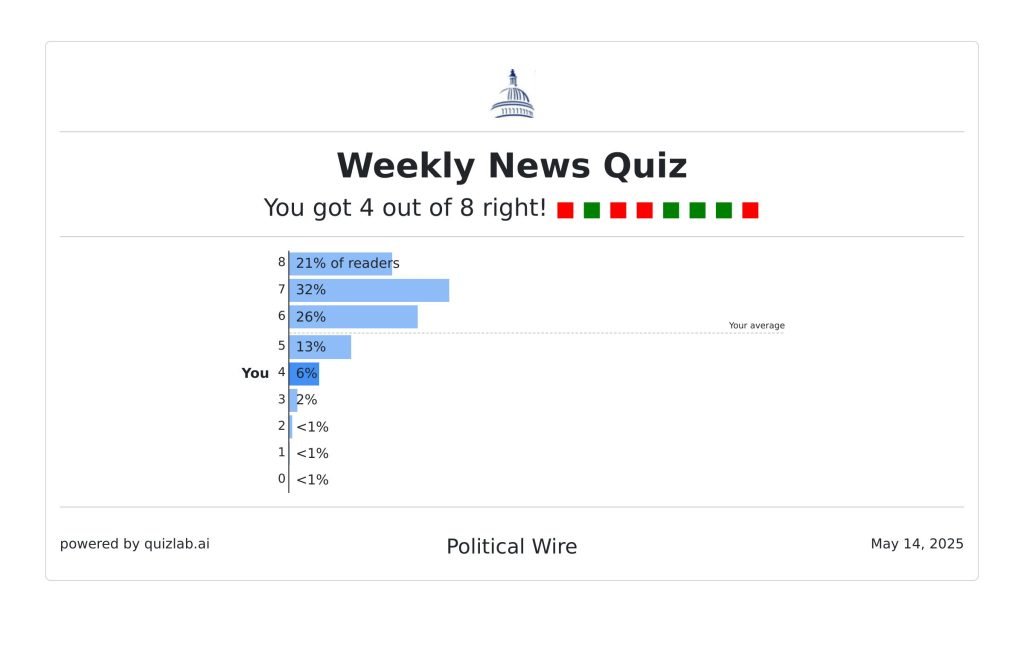
It’s awesome to see our first quiz live in the wild on Political Wire.
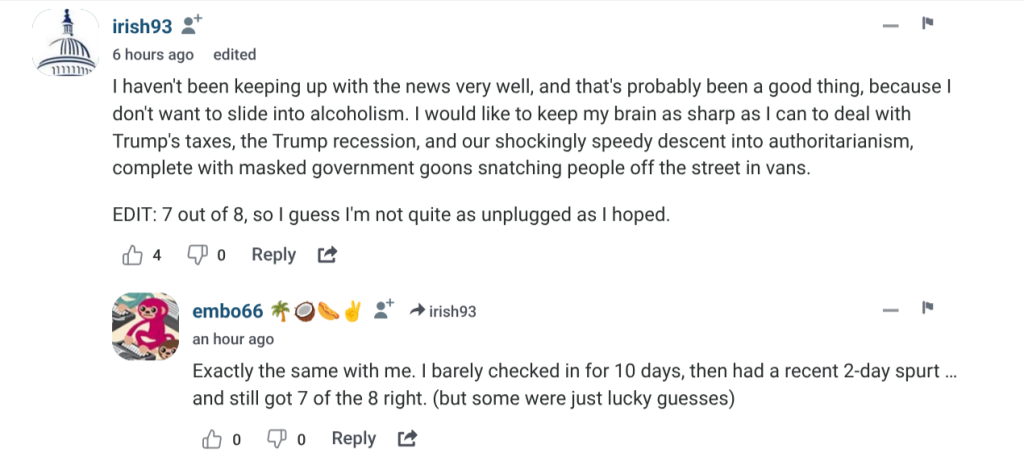
Some readers have used the quiz as a wellness check…
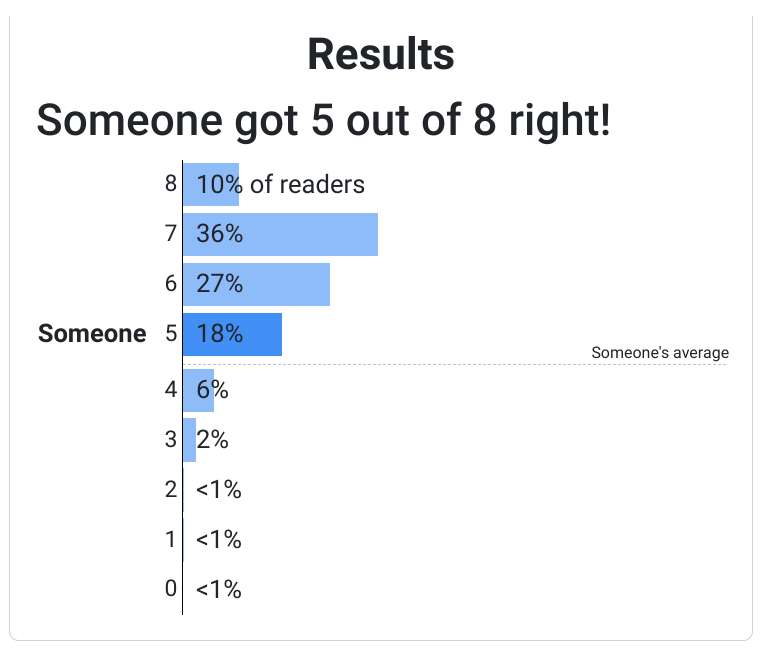
My score suggests I need to pay closer attention.
> Competition > Community > Socializing
One of the thing that’s always fascinated us in working on Racery.com is how powerfully competition ties into community and socializing.
Do all competitions create community? And do all communities spawn competitions?
Competitions create gatherings. Competitions create ceremonies. Competitions create repetition. Competitions allow us to present our selves to others. Competitions structure our interactions. Competitions create pecking orders. Above all else, competitions create conversations.
BBC to AI: grow up!
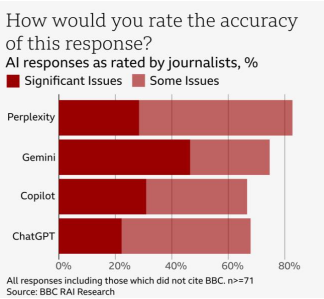
The venerable BBC discovered significant deficiencies when testing AI’s ability to accurately answer questions about the news.
“We gave the AI assistants [OpenAI’s ChatGPT; Microsoft’s Copilot; Google’s Gemini; Perplexity] access to our website for the duration of the research and asked them questions about the news, prompting them to use BBC News articles as sources where possible.”
In the study, conducted in February 2025, journalists reviewed AI’s answers to 100 popular questions about content covered by the BBC. In all, 45 journalists graded 362 AI responses.
Here’s a summary of their findings:
- 51% of all AI answers to questions about the news were judged to have significant issues of some form.
- 19% of AI answers which cited BBC content introduced factual errors – incorrect factual statements, numbers and dates.
- 13% of the quotes sourced from BBC articles were either altered from the original source or not present in the article cited.
More AI-powered reporters
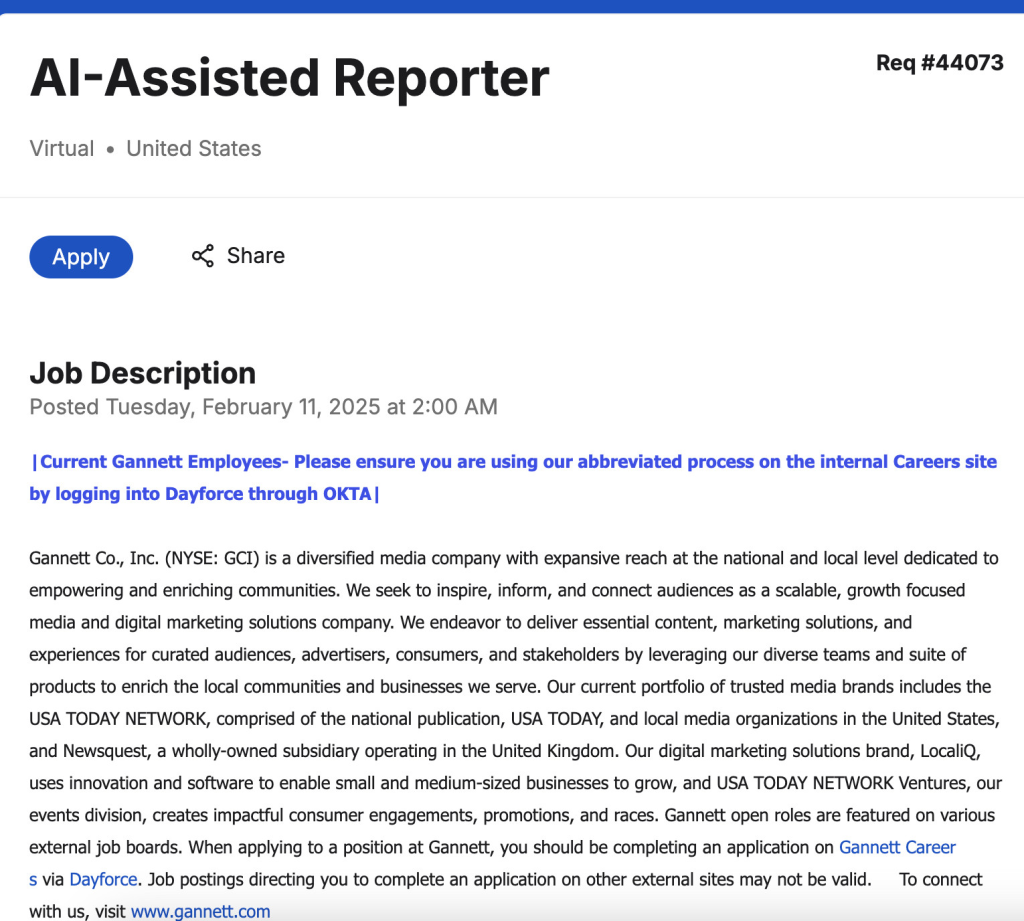
The nomenclature is perhaps redundant… what white collar job isn’t AI-assisted these days?
NYTimes.com unveils an arsenal of AI tools for editorial, business and production staff
Recognizing that publishing is no longer just a matter of creating and distributing content — news, features, editorials, graphs, stock tables, and photos — NYTimes.com is giving front-line editorial staff a slew of new AI-powered editorial tools and processes, reports Semafor.
One of these tools allows staff to create quizzes with the help of AI, a service like what Quizlab provides.
Other AI tools now available to NYT staff will aid in the creation of:
- social copy
- quote cards
- FAQs
- summarization of Times articles, briefings, and interactives
Other tools for broader NYT staff include:
- GitHub Copilot programming assistant for coding
- Google’s Vertex AI for product development
- NotebookLM
- the NYT’s ChatExplorer
- some Amazon AI products
- OpenAI’s non-ChatGPT API
“The paper encouraged editorial staff to use these AI tools to generate SEO headlines, summaries, and audience promos; suggest edits; brainstorm questions and ideas and ask questions about reporters’ own documents; engage in research; and analyze the Times’ own documents and images,” according to Semafor.
Grow subscriptions with Quizlab’s AI-optimized quizzes
Hustling to retain and grow its readership, NYTimes.com now has 100 staffers working on games. Even Netflix is has added games adjacent to shows like Stranger Things.
How can you, an independent creator, compete with that corporate firepower?
We’re the quizmaster for creators. Whether you’re monetizing a Substack, podcast, Youtube channel, or Patreon, Quizlab helps you add value for subscribers, boost loyalty, and reduce churn. (Read why churn is the make-or-break metric for publishers… the numbers are stark!)
Our company has been building tools for online publishers since 1998.
Publishers who think they’re in the business of simply creating great content are discovering that this means nothing if casual readers don’t become loyal patrons.
Our turnkey quizzes generate on-brand content that adds value to your subscription bundle. And our gamification mechanics — leader boards, perfection scores, and streak awards — boost reader loyalty. Most importantly, our quizzes amuse your readers!
Quizlab uses AI to reduce the effort needed to create a smart quiz by 90% or more. That saving frees up editorial staff for high-value creative work, just when every publisher — from the nichiest Substack to NYTimes.com — is striving to hold on to more readers while expending fewer staff hours.
Quizlab’s quizzes based on your content will:
- Entertain readers
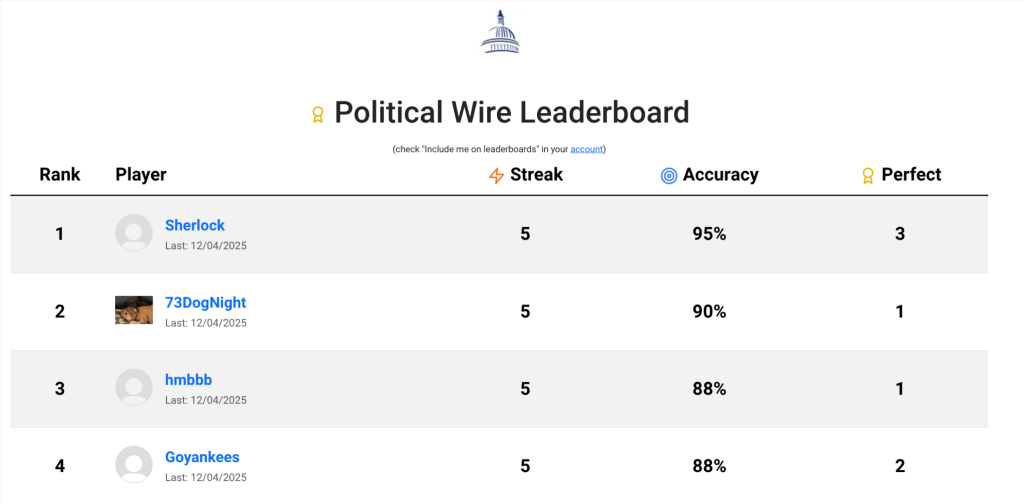
- Boost stickiness with a leader board of your readers
- Increase subscriber loyalty
- Create extra fodder for commenters
- Drive social sharing of quiz histograms
- Emphasize important news
- Build community as people compare results
- Deepen content engagement
- Conserve scarce staff-time
- Surprise readers with clever questions and answers
To automate quizzes based on your content, contact info@email.quizlab.ai for a personal tour of our software and blueprint for using quizzes to retain subscribers!
Quiz result histograms
Every quiz concludes with an easy-to-share jpg that includes the quiz-taker’s answer sequence, a histogram of everyone’s results, and the average of the quiz-taker’s results over time. Quiz leaderboard
Participants can optionally create IDs and compete in the community leader board. Quiz question feedback
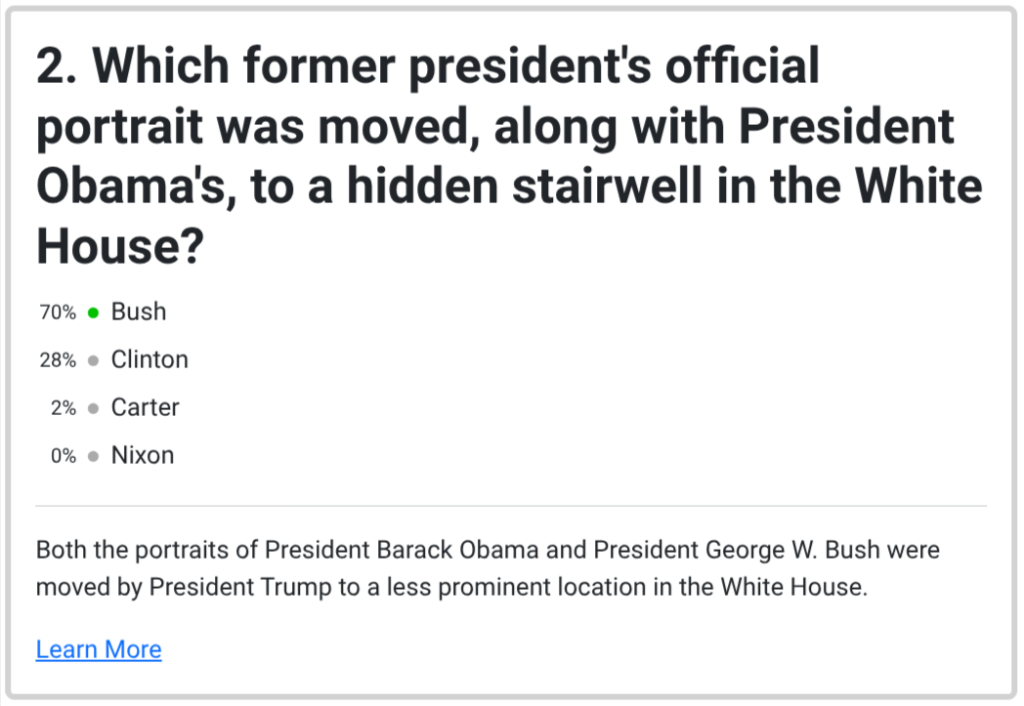
Quiz takers can compare their results with the answers that other participants have given, a post-race summary of all questions and answers is also published. .
What’s a game?
Ludwig Wittgenstein, the great 20th century philosopher of language and logic, was intrigued by games. For Wittgenstein, language was itself a game, and games, themselves, were a prime illustration of the fluid interplay in language between fixed rules and the primal human need for flexibility.
In Wittgenstein’s view, the boundaries of the word “game,” though commonly invoked without much thought, were hazy or nonexistent. Like a ghost, the exact meaning of game flees whenever we draw too near and examine it closely.
As games are examined, their “similarities crop up and disappear,” according to Wittgenstein. However, it seems to me that if we stop trying to define what a game is and instead look at what role games play in life, “game” can be reliably defined.
Before getting to that idea, first, here’s Wittgenstein in aphorisms 66 and 67 of Philosophical Investigations:
Consider for example the proceedings that we call “games.”
I mean board-games, card-games, ball-games, Olympic games, and so on. What is common to them all?—Don’t say: “There must be something common, or they
would not be called ‘games’”—but look and see whether thereis anything common to all.—For if you look at them you will not see something that is
common to all, but similarities, relationships, and a whole
series of them at that. To repeat: don’t think, but look!Look for example at board-games, with their multifarious
relationships. Now pass to card-games; here you find many
correspondences with the first group, but many common
features drop out, and others appear. When we pass next to ball-games, much that is common is retained, but much is lost.—Are they all ‘amusing’? Compare chess with noughts and
crosses. Or is there always winning and losing, or competition between players? Think of patience [Solitaire]. In ball-games there is winning and losing; but when a child throws his ball at the wall and catches it again this feature has disappeared.Look at the parts played by skill and luck; and at the difference between skill in chess and skill in tennis.
Think now of games like ring-a-ring-a-roses; here is the
element of amusement, but how many other characteristic
features have disappeared!And we can go through the many, many other groups of games in the same way; can see how similarities crop up and disappear. And the result of this examination is: we see a complicated network of similarities overlapping and crisscrossing: sometimes overall similarities, sometimes
similarities of detail.I can think of no better expression to characterize these
similarities than “family resemblances”; for the various
resemblances between members of a family: build, features,
colour of eyes, gait, temperament, etc. etc. overlap and crisscross in the same way. —And I shall say: ‘games’ form a family.At the risk of appearing to pick a fight with Wittgenstein, I believe games are, no matter what their definition, a fundamental building block for communities. Like language, they are agreed structures that allow and foster meaningful interaction. (Even Solitaire is the seed for socializing between teacher and student, peer players (comparing lucky runs) and the player’s present self with the experience of past selves.)
And all games have distinct effects, effects that are regular and predictable enough that the effects might be codified and, in turn, used to help define “game.” (Would it be stretching logic to say “everything that produces the same effects as a game is a game” or are there exceptions to that rule?)
The common effects of games can be untangled into the following strands:
- Agreement: Even the most competitive games start with agreement — these are the rules, this is the goal, these are the spacial and behavioral edges of our field of play.
- Interaction: Participating in a game requires interaction — either with opposing participants, team mates, referees, spectators, or, at the very least (in the case of Solitaire, for example) a teacher.
- Collaboration: Nearly all games require collaboration. Team members work together to achieve a goal and even opponents must collaborate by abiding by common rules and taking turns.
- Identity: All players of a given type of game assume an identity as players of that game by grace of their common knowledge of the rules, investment of some portion of their lives in the game, their shared status in the community.
- Conversation: Beyond the process of “doing” a game, players engage in meta-conversations on, within, around that game.
- Primacy: Notwithstanding Wittgenstein’s erroneous claim that throwing a ball against the wall is a game, games all have a winner and/or loser, players who succeeds or fails at fulfilling the assigned task.
- Order: Like a crystal’s seed, public awareness of a player’s success contributes to a lattice-work of heirarchies that buttress and stabiliz the society around the game.
As noted above, these effects might themselves be used to create a sociological or psychological (or phenomenological?) definition of “game.” But we’ll play that game another day.
Meanwhile, go read what AI thinks of this blog post!